

Filling the Gap in High-Layer, High-End, and High-Difficulty Server Board Manufacturing to Boost the Rapid Development of the AI Electronics Industry
In the era of the digital economy, AI and big data technologies are reshaping the global industrial landscape. According to a McKinsey report, the global AI market size reached 1.5 trillion US dollars in 2024, with a compound annual growth rate (CAGR) exceeding 25%; International Data Corporation (IDC) predicts that in the next two years, global spending on big data analytics will exceed 300 billion US dollars, driving exponential growth in demand for servers in data centers.

The core supporting all of this is the server motherboard — they are like the 'brain' of AI systems, making the PCB substrates serving AI computing the lifeblood of the electronics industry. These motherboards need to carry high-speed chips such as CPU and GPU to ensure the real-time performance of massive data processing. However, the design and manufacturing threshold of such PCB is extremely high: they require an 18-layer or more, 4-8order HDI (High-Density Interconnect) structure, and use high-frequency and high-speed materials as substrates. Unfortunately, there are very few manufacturers capable of producing such high-end PCB currently, especially in the field of sample and small-batch manufacturing, which is almost a blank, seriously restricting the pace of innovation in the AI era.

As a leading enterprise deeply engaged in the HDI PCB manufacturing field for 10 years, since 2014, SunKey Electronics has taken 'technology-driven and process breakthrough' as its core, focused on high-reliability and high-precision manufacturing, continuously improved its technology in the field of small-batch HDI PCB manufacturing, and gradually filled the gaps in multiple high-difficulty HDI PCB manufacturing processes. With ten years of accumulation in fine wire and microvia technology, the company has established a leading position in the small-batch manufacturing of large server substrates.
This article will start with the current status of the AI wave, deeply analyze the characteristics, supply bottlenecks of server substrate PCB, SunKey Electronics' solutions, and look forward to the future development blueprint, calling on the industry to work together to help the transformation of the AI electronics industry and contribute valuable efforts to the localized replacement of large server substrates.
Industry Status and Demand Data
Currently, artificial intelligence and big data technologies have moved towards large-scale commercialization. IDC data shows that the global AI server market reached 30.7 billion US dollars in 2023, a year-on-year increase of 35.6%; it is expected to exceed 90 billion US dollars by 2028, with a CAGR as high as 24%. Among them, cluster servers for training large models have particularly harsh hardware requirements, and each GPU node needs to be equipped with a high-performance motherboard. For example, NVIDIA's OGX SuperPOD system uses an 8-layer HDI PCB motherboard to support PB-level data throughput per second.

Big data analytics is also driving demand. According to Statista, a global comprehensive data statistics platform, the global data volume reached 120 ZB (1 ZB = 1 billion TB) in 2023 and will increase to 180 ZB by 2025. Cloud computing giants such as Amazon AWS and Microsoft Azure need to deploy millions of servers: alone, Google's data centers added more than 1 million new servers in 2023, an increase of 28% over the previous year. These server motherboards need to support high-frequency computing (such as 5GHz or higher frequency for 128-core CPU) and low-latency transmission, thus making 18-layer or more PCB the standard configuration for motherboards. According to a report by Prismark, an industry research institute, the global high-end server PCB market size reached 18 billion US dollars in 2023, of which 18-24 layer PCB accounted for more than 60%; the demand is expected to increase to 25 billion US dollars by 2025, with an annual growth rate of more than 20%.
Specific demand data is as follows:
Layer Requirement: The average number of layers of AI server motherboards has jumped from 14 layers in 2019 to 18-22 layers in 2024. Dell's PowerEdge series motherboards have adopted a 20-layer design to meet AI inference loads.
Characteristics and Manufacturing Secrets of PCB Substrates for Servers
PCB substrates suitable for large AI servers can be called the pinnacle of electronic manufacturing. Their characteristics can be summarized as 'five highs': high layer count (>18 layers), high-frequency signals (GHz-level transmission), high-speed data (Gb/s-level rate), high order (4-8order HDI structure), and high density (line width/spacing ≤50μm). Taking a typical 8-layer HDI server motherboard as an example: 20-layer copper clad stacking, with millions of microvias interconnecting between layers to carry 128 high-density BGA chips, and the overall thickness is controlled within 2mm. In terms of materials, high-frequency and high-speed substrates such as Rogers R04350B, Panasonic R5785N, and Taiyo TU883 dominate the market, and their Dk value must be stable within the range of 3.4±0.05.
Core Product Characteristics are as Follows:
- High-Layer Structure (18-30 layers): Multi-layer stacking ensures power integrity. For example, a 24-layer PCB needs to integrate 12 signal layers, 8 power layers, and 4 ground layers to reduce noise interference. The key technical point is the alignment accuracy between layers (error<5μm); if the deviation exceeds 10μm, the signal reflectivity will increase by 15%, causing AI computing errors.
- High-Frequency and High-Speed Characteristics: The frequency rises to 5-10GHz to support DDR5 memory (bandwidth 6.4Gbps). The difficulty lies in dielectric control: the material needs to have a Df<0.002 at='' otherwise='' the='' signal='' loss='' will='' surge='' for='' when=''>3dB/inch, the transmission distance is halved). High-speed transmission relies on impedance consistency (100±5%), which requires precise calculation of differential pair line width (±2μm error) to avoid an increase in data center bit error rate.
- High-Order HDI (4-8 orders): High order means an ultra-microvia interconnection structure. A 4-order HDI requires 4 times of laser drilling with an aperture of 0.1mm; an 8-order HDI requires 8 times of lamination laser drilling. Under high density, the number of microvias per square inch exceeds 5,000.
- High-Density Interconnection: The line width/spacing is reduced to below 50μm/50μm (the diameter of a human hair is about 70μm), and the pin density reaches 200pin/cm. This requires 'zero blind via' technology — all layers of through-holes, blind vias, and buried vias are integrated to ensure low signal latency (<10ps/inch).

Manufacturing Process Difficulties and Key Technical Points
The production process of such PCB is comparable to micro-sculpture art, and its key technical points are mainly reflected in the following four aspects:
- Interlayer Alignment and Lamination Control: PCB with 18 or more layers require 3+ times of lamination, which is prone to layer deviation and short circuits.
- Microvia Technology: Laser drilling needs to penetrate 2-4mil apertures, which is prone to 'taper defects' and 'pad separation', affecting conductivity. The key technology is pulse energy regulation: when the energy<20μJ/pulse, the success rate exceeds 98%.
- Signal Integrity Assurance: The skin effect is enhanced at high frequencies, requiring 'gold plating' (electroless gold deposition + electroplated nickel-gold) to ensure impedance stability. The difficulty lies in plating uniformity (±0.05μm variation).
- Material Thermal Management: The coefficient of thermal expansion (CTE) of high-frequency materials must match that of copper foil (16 ppm/℃), otherwise the risk of delamination during high-temperature reflow soldering increases by 40%.

Behind these process difficulties lies a deep investment black hole: a single high-order HDI PCB production line requires an investment of more than 50 million yuan. Without several years of technical accumulation, it is almost impossible to achieve reliable mass production. SunKey Electronics has increased the yield rate to over 95% through the 'four-step process' (precision drilling → high-layer lamination → high-precision etching → signal testing).
Supply Status of PCB Substrates for Servers
The acceleration of AI innovation has exposed the shortcomings of the supply chain. According to a 2023 Prismark report, fewer than 10 PCB factories worldwide can stably mass-produce high-order HDI motherboards with 18 or more layers, and 90% of the production capacity is monopolized by overseas giants such as Samsung and TTM. Other manufacturers mainly focus on large-batch orders (10,000 pieces or more), and the field of sample and small-batch manufacturing (1-500 pieces) is even in a vacuum: the supply-demand gap is as high as 30%, and 80% of AI start-ups report that motherboard delivery is delayed by 7-9 weeks.
Supply shortage data is as follows:
- Unbalanced Capacity Distribution: In 2024, the average delivery cycle for samples and small-batch high-order HDI PCB worldwide has been extended to 8 weeks (the standard is 2-4 weeks).
- Cost and Economic Barriers: Small-batch trial production requires resetting the production line, leading to a 60% cost surge. Small and medium-sized factories are deterred by the extremely high equipment investment.
- Technical Threshold Restrictions: 40% of PCB factories are blocked from server substrate manufacturing due to insufficient lamination control and microvia technology.
- Regional Concentration Issue: 70% of the production capacity is concentrated in Taiwan and South Korea (such as Samsung, Unimicron, etc.), and the absence of Europe and the United States leads to tariff risks. Under the geopolitical conflicts from 2023 to 2024, the import cycle and cost of sample and small-batch server substrates have surged by more than 30%.
The root cause of the shortage lies in the 'three-high paradox': high investment (50 million yuan/line), high risk (20% sample failure rate), and high technical barriers (the 'five highs' characteristics). The shortage of samples directly stifles innovation. The director of Tesla AI once publicly criticized PCB suppliers for delaying the iteration of Autopilot. In this context, SunKey Electronics has pioneered the localized manufacturing of small-batch server substrates through special research and development.
SunKey Electronics' Efforts and Achievements
As a pioneer of high-difficulty HDI PCB in China, SunKey Electronics has anchored its mission of 'high reliability, high precision, and high precision' since its establishment in 2010. The technical team of the company's Product Research Institute focuses on the segmented field of server motherboards, and ten years of accumulation have forged four major technical pillars: fine wire technology, interlayer alignment technology, microvia technology, and signal integrity control technology. SunKey's technical code lies in 'polishing a sword for ten years': breaking through the 6-order HDI PCB engineering sample process in 2023, realizing the mass production of 8-order HDI PCB in 2025, and pre-researching 12-order technology in 2028. This achievement is not only a microcosm of innovation and transformation in electronic manufacturing in the Industry 4.0 era but also an enabling engine for the rapid development of the domestic AI electronics industry.
The following are some representative products of server substrates mass-produced by SunKey Electronics, with relevant information attached.
Example 1:
- Product Model: PA01130C30
- Material: Panasonic R5785N
- Board Thickness: 3.0mm
- Number of Layers: 30
- Minimum Hole (CNC): 0.35mm
- Minimum Hole (Laser): 0.075mm
- Minimum Line Width/Spacing: 0.09/0.127mm
- Hole to Line: 0.16mm
- Product Features: 5 times back drilling, 4 times laser drilling, 4-order blind vias

Example 2:
- Product Model: AE99052C24
- Material: RO4003 & TU883
- Board Thickness: 2.8mm
- Number of Layers: 24
- Minimum Hole (CNC): 0.25mm
- Minimum Hole (Laser): 0.05mm
- Minimum Line Width/Spacing: 0.075/0.075mm
- Hole to Line: 0.13mm
- Product Features: 5 times lamination, 4 times laser drilling, 4-order HDI

Example 3:
- Product Model: JB43404F18
- Material: Panasonic R5775G
- Board Thickness: 2.0mm
- Number of Layers: 18
- Minimum Hole (CNC): 0.25mm
- Minimum Hole (Laser): 0.05mm
- Minimum Line Width/Spacing: 0.075/0.082mm
- Hole to Line: 0.15mm
- Product Features: 4 times laser drilling, 4-order HDI, gold finger with thick gold of 30μm
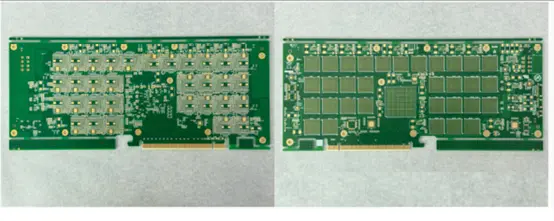
Looking back, SunKey Electronics' technical route is highly consistent with the industry development direction: from 'manufacturing services' to 'innovation partners', striving to fill every gap in domestic AI electronics. SunKey's mission in this field is to make every AI inspiration see the light of circuits.
Join Hands with SunKey to Start the Golden Decade of AI Electronics
Artificial intelligence and big data technologies are reshaping human civilization, and their foundation is every signal transmission of server motherboards. The 'five highs' HDI PCB forged by SunKey Electronics with ten years of exquisite craftsmanship are exactly the cornerstone of this era. Starting from the upsurge of the current AI situation, the company has analyzed the high-level characteristics and manufacturing pain points of products, revealed the cruel reality of supply shortages, and demonstrated SunKey's breakthrough efforts in the small-batch field — this is not only the hard work of an electronic manufacturing enterprise but also a historical footnote to China's manufacturing transformation from following to leading.
The future has arrived: for every 1% growth in the AI server market, tens of millions of high-performance PCB are needed for support. SunKey promises: to take technology-driven as the engine, continue to fill the gaps, and accelerate the implementation of innovation. We sincerely invite global partners — whether you are an AI maker or a cloud giant — to join our journey. Let every engineering sample and small-batch server motherboard become a spark driving the intelligent world.
Let us work together to help the AI electronics industry enter a golden decade of infinite possibilities


 :
: :
: : A1 Building,Ditang Industrail B zone,Shajing Street,Bao'an
  :+86 13244860273

